 Sioux Falls Egress Windows
 Window Well Installation & Replacement in Sioux Falls
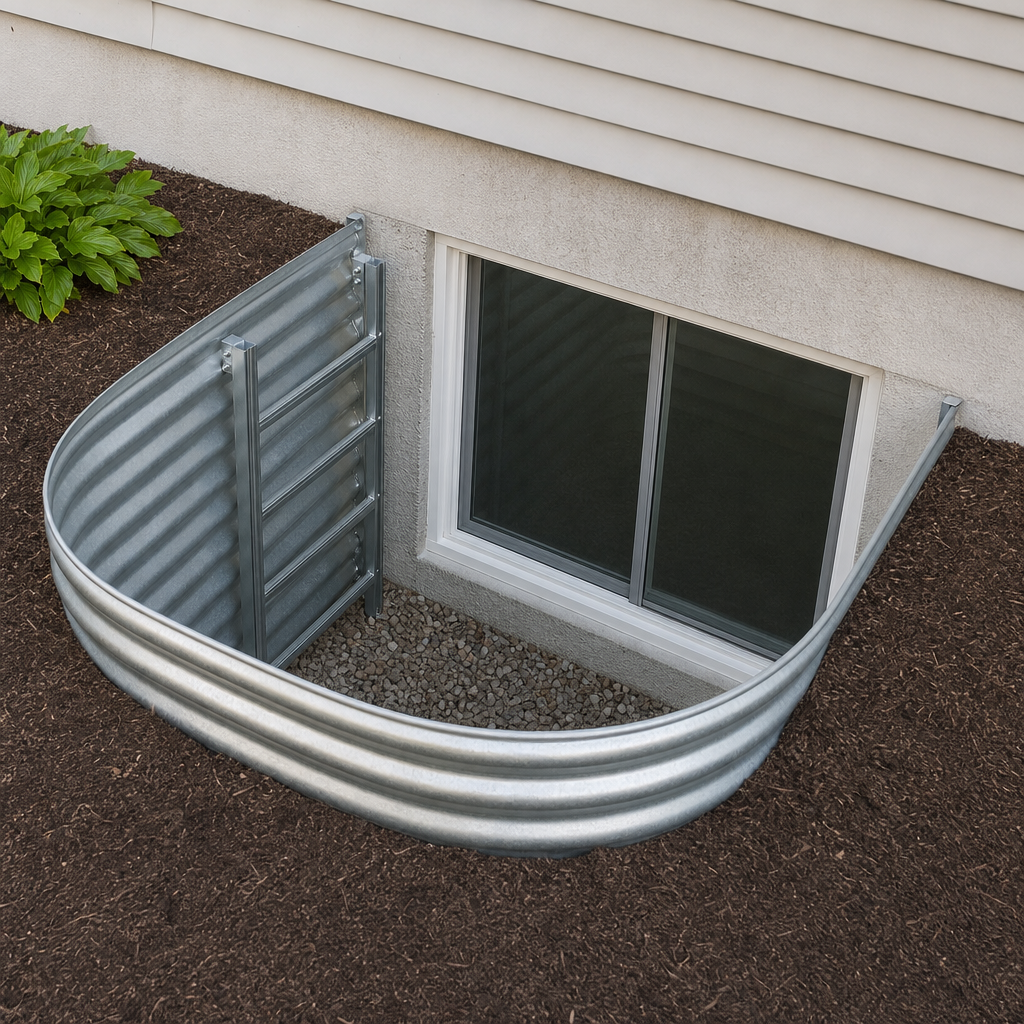
A window well holds back five-plus feet of Sioux Falls clay so your egress window can exist below grade, and under IRC R310 it has to measure at least 9 square feet, minimum 36” × 36”, with a permanent ladder when it’s deeper than 44 inches. We install code-sized wells with anchored ladders and real gravel drainage, whether that’s part of a new egress cut or a replacement for a rusted-out well that floods every March. Replacement on an existing opening runs $1,000–$3,000.
Wells are the unglamorous half of egress work, and they’re where this climate does its damage. Sioux Falls freezes to a 42-inch frost depth, thaws, soaks, and freezes again, and every cycle works on the steel, the anchors, and the drainage under the well. Here’s what a well has to do, what the code demands, and how we build ones that last.
What the code requires, and why each rule exists
9 square feet, 36” × 36” minimum. That’s the space a firefighter in gear needs to crouch in front of the window and help someone out. Wells sized to “look about right” are one of the most common failures on DIY and handyman egress jobs. A 30-inch projection fails inspection no matter how nice the window is.
A permanent ladder above 44 inches of depth. Rungs at least 12 inches wide, projecting at least 3 inches from the wall, spaced no more than 18 inches on center, and permanently attached, a garden ladder leaned in the well doesn’t count. At typical Sioux Falls sill depths, plan on the ladder. Ours anchor to the well or the foundation, not to the dirt.
The window itself has to hit the R310 opening numbers, 5.7 square feet net clear, 24” height, 20” width, 44” max sill, which is the egress window installation side of the job. A perfect well around a non-compliant window is still a failed inspection.
Drainage: the part that separates good wells from wet basements
A window well is a bucket set against your foundation. Without a working drain, it fills (with rain, with snowmelt, with the spring thaw that our silty clay refuses to absorb) and the water sits against your window until it finds a way in.
Every well we set goes over a deep gravel drainage bed. Where the house has footing drain tile (most poured-foundation homes from the last few decades do), we tie the bed into it so well water exits through the same system that drains the footing. Where there’s no tile, common under Sioux Falls’ 1950s–70s ranches and the pre-war homes near the core, we dig the gravel column deeper into a dry well that gives water somewhere to go besides your basement.
If your existing well floods but the well body is sound, drainage rehab alone runs $300–$1,000, details on the covers and drainage page, along with the polycarbonate covers that keep rain and snow out of the well in the first place. In this climate a cover isn’t decoration; an uncovered well collects two feet of snow and then melts it against your window in April.
Well materials, priced honestly
| Material | Typical installed cost | The honest tradeoff |
|---|---|---|
| Corrugated galvanized steel | $1,000–$1,600 | Cheapest, code-fine, rusts eventually, 15–25 years here |
| Composite / structural plastic | $1,600–$2,400 | No rust, cleaner look, costs more |
| Stone-texture / terraced systems | $2,200–$3,000 | Best looking, easiest to climb, top of the range |
All three pass code when sized and anchored right. Steel is the value pick and most of what we install; composite earns its premium on wells you’ll see from a finished bedroom window. What we won’t install is a well set loose against the wall, every well anchors to the foundation, because frost heave moves anything that isn’t attached.
Replacement: what’s actually involved
- Dig out around the failed well, usually a couple feet beyond it on all sides.
- Remove the old well and inspect the wall, flashing, and window behind it. (This is when the problems the flooding caused show up, better now than after backfill.)
- Rebuild the base: excavate the silted clay, place the gravel drainage bed, tie to drain tile where it exists.
- Anchor the new well and ladder to the foundation.
- Backfill and grade away from the house, and fit the cover if you’ve ordered one.
One day for most wells. No permit is needed for a like-for-like well replacement in most cases; if we’re enlarging the opening or the well serves a new egress cut, the permit comes with the main install and we handle it either way.
Sioux Falls-specific well problems we fix weekly
- Frost-heaved wells pulled off the wall an inch or two, letting soil pour in behind. The freeze-thaw cycle here is genuinely hard on unanchored wells.
- Rusted-through corrugated steel on 1980s–90s installs across the older ring suburb neighborhoods; the steel had a good run, it’s over.
- Silted drainage under wells in the clay-heavy soils common across the metro. The gravel bed was fine for a decade, then the fines sealed it.
- Undersized “light wells” on older homes near McKennan Park and All Saints that were never egress wells at all, fine for a glass-block window, not legal for the bedroom someone finished down there. That’s usually a full code compliance upgrade, and we’ll say so rather than sell you a well that won’t pass.
Get a number for your well
Send a photo of the well (inside it, if you can do that safely) plus your town. Sioux Falls, Harrisburg, Brandon, Tea, and Hartford are all regular routes. Free on-site measure, flat quote (wells are quick to price, so the number usually comes the same day as the look) and if the honest answer is “your well has five more years, save your money,” that’s the answer you’ll get. Pricing for everything is published on the pricing page.
Frequently Asked Questions
What does window well replacement cost in Sioux Falls?
Typically $1,000–$3,000 for a well on an existing opening, corrugated galvanized steel at the low end, composite or stone-texture wells at the high end. Rebuilding the gravel drainage bed underneath adds $300–$1,000 if yours has silted up. Flat quote after a free measure.
What size does an egress window well have to be?
IRC R310 requires at least 9 square feet of horizontal area with a minimum 36 inches of width and 36 inches of projection from the wall. If the well is deeper than 44 inches, normal at Sioux Falls sill depths, it also needs a permanently attached ladder or steps.
Why does my window well fill with water every spring?
Almost always drainage: the original installer set the well on native clay with little or no gravel, or the gravel bed has silted shut. Sioux Falls' silty clay holds water, so snowmelt collects in the well and finds your window. The fix is excavating the base, rebuilding a deep gravel bed, and tying it to the footing drain tile where one exists.
How long does a well replacement take?
Usually one day: dig out around the old well, remove it, rebuild the gravel base, anchor the new well and ladder to the foundation, backfill, and grade. Weather and depth can stretch it, but this is not a week-long project.
Do rusted steel wells actually need replacing?
When rust has eaten through the wall or the anchors, yes, a collapsing well pushes soil against the window and frost heave finishes the job. Surface rust alone isn't urgent. We'll tell you which you have; about a third of the wells we look at can wait.
More egress services
Areas we serve
- Sioux Falls, SD
- Egress Window Installation in Brandon, SD
- Egress Window Installation in Canton, SD
- Egress Window Installation in Dell Rapids, SD
- Egress Window Installation in Harrisburg, SD
- Egress Window Installation in Hartford, SD
- Egress Window Installation in Lennox, SD
- Egress Window Installation in Mitchell, SD
- Egress Window Installation in Tea, SD
- Egress Windows and Window Wells in Sioux City, IA